
What Is TikTok? A Complete Beginner's Guide
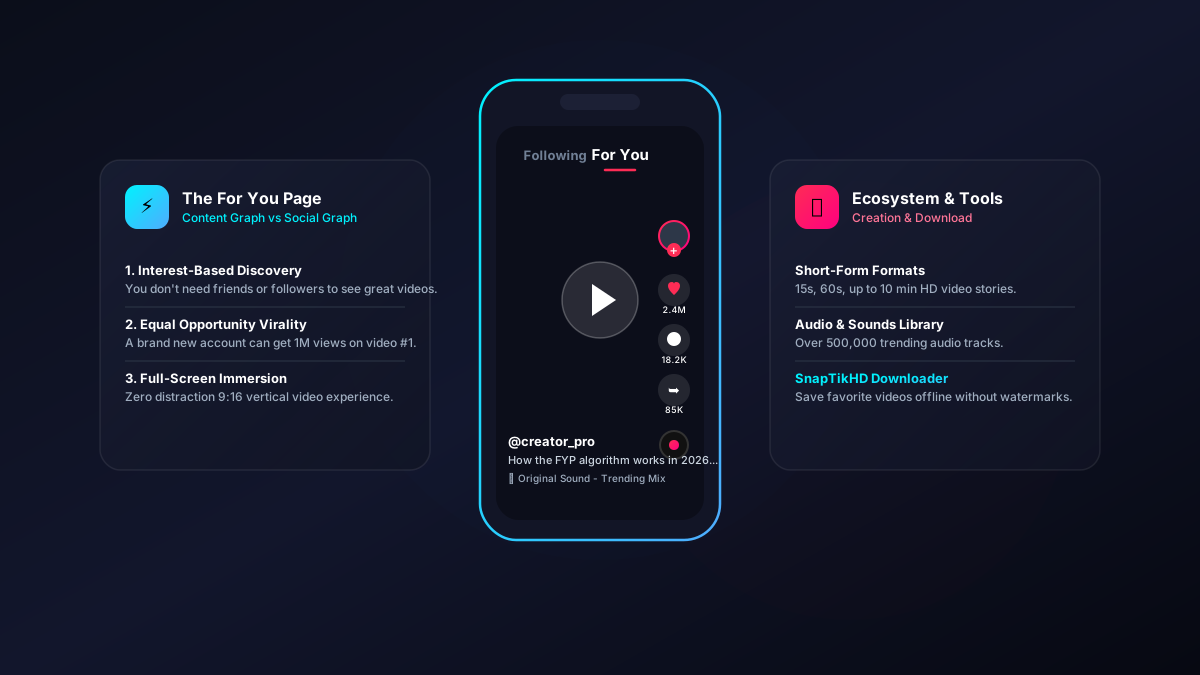
TikTok is a short-form video app where the main screen shows you videos chosen by software rather than by you. That one design decision — a feed of strangers instead of a feed of friends — is what separates it from everything that came before, and it explains almost everything else about how the platform behaves. Here is the whole thing from the beginning.
The basics
TikTok is owned by ByteDance, a Chinese technology company. It launched internationally in 2017 and absorbed Musical.ly, a lip-syncing app with a large teenage user base, the following year. That merger is why early TikTok was dominated by dance and lip-sync content, and why people who have not looked at it since still think that is all it is.
It is now one of the most-used apps in the world, with over a billion monthly active users, and the content has broadened completely. Cooking, carpentry, medicine, history, law, book reviews, farm machinery, language learning, small-business marketing — if a subject has an audience, it has a corner of TikTok.
The app is free. Videos can run from a few seconds up to ten minutes recorded in-app, with longer uploads possible from a desktop browser. Most successful videos are between fifteen and sixty seconds.
The For You Page is the whole product
When you open TikTok you land on the For You Page, usually shortened to FYP. It is a single, full-screen, vertically scrolling stream of videos selected for you by a recommendation system.
This is the part that is genuinely different. On most social platforms, what you see is determined by who you follow: build a network first, get content second. On TikTok the default feed is built from what the system thinks you will watch, and whether you follow the creator barely matters.
Two consequences follow, and they shape the entire culture of the platform:
- A brand-new account can reach millions. There is no audience-building prerequisite. Your first ever video is eligible for the same distribution as an account with five million followers.
- A large account can post to silence. Followers are not a guaranteed audience. Every video is judged more or less on its own.
This is why people describe TikTok as a lottery, and why it attracts creators who have been unable to get traction elsewhere. It is also why consistency matters more here than almost anywhere else — you are buying tickets, not building a mailing list. We go much deeper into the mechanics in how the TikTok algorithm works.
Finding your way around the interface
Five icons run along the bottom of the screen.
- Home — the feed. Swipe between the For You tab and the Following tab, which shows only accounts you follow, in something closer to chronological order.
- Discover (or Friends, depending on your version) — search, trending hashtags and sounds.
- + — the create button, which opens the camera and editor.
- Inbox — notifications, comments, and activity on your videos.
- Profile — your own account, your posted videos, your drafts, and settings.
Down the right-hand edge of every video sits a vertical column: the creator's avatar, a heart (like), a speech bubble (comments), a bookmark (save), and an arrow (share). At the bottom left is the caption and the creator's username; at the bottom right, a spinning record showing which sound the video uses.
Tapping that spinning record is one of the more useful things a newcomer can learn. It opens a page of every other video using the same sound — which is how trends spread, and how you find the format a video you liked was built on.
The vocabulary
| Term | What it means |
|---|---|
| FYP | For You Page — the algorithmic main feed |
| Sound | The audio track attached to a video; tap it to see everyone else using it |
| Duet | Your video plays side by side with someone else's |
| Stitch | You clip up to five seconds of someone's video and continue from it |
| Green screen | An effect that puts an image or video behind you as a background |
| CapCut | ByteDance's free video editor, used by a large share of serious creators |
| Niche | The subject area your account consistently covers |
| Watermark | The TikTok logo and username added to videos saved through the app |
Why people post
It is worth separating the motivations, because they lead to completely different strategies.
Reach without a network. For anyone starting from nothing — a new business, a writer, a musician, a tradesperson — TikTok is the cheapest distribution available. No advertising budget, no existing audience, no gatekeeper. That is a genuinely unusual offer and it is the main reason serious people put up with the format.
Money. There are now several direct routes, from the Creator Rewards Program to LIVE gifts to selling through TikTok Shop, and an indirect one — brand sponsorship — that is generally worth more than all of them. Each has follower and view thresholds, which we set out in how to make money on TikTok.
Customers. Small businesses use it as a shop window. A joiner filming what they are making, a café showing its morning prep, a bookshop recommending titles — these accounts work because the content is the product demonstration.
Craft and community. Plenty of people post because they enjoy making things and because the comment section of a niche subject is where the other people who care about it are.
Search. A large and growing number of users, particularly under 30, now search TikTok the way they would search Google — for recipes, product reviews, how-to instructions and local recommendations. Posting is a way of being findable.
What makes a video work
Without pre-empting the growth guides, three things separate videos that travel from videos that do not.
The first second. The feed is one swipe away at all times, and most abandonment happens almost immediately. Videos that open with a slow build lose. Videos that open with the interesting part — the finished object, the surprising claim, the question — hold.
Completion. Whether people watch to the end is the strongest single signal you control. This is why short videos often outperform long ones: a fifteen-second video finished by 70% of viewers sends a better signal than a two-minute video abandoned at twenty seconds.
Clarity. A video about one clear thing outperforms a video about several. Vague content gives the recommendation system nothing to work with and gives the viewer no reason to stay.
Getting started sensibly
- Watch before you post. Spend a week scrolling and actively training the feed — finish videos in your subject area, skip the rest, follow relevant accounts, search your topic. The FYP becomes a research tool once it understands you.
- Pick a subject. Not a format, a subject. "Budget cooking for students" is an account. "Funny videos" is not.
- Post ten times before you judge anything. The first few videos of any account are noise. Patterns appear around the tenth.
- Read your analytics. Watch time and completion rate will tell you more in a week than a month of guessing. See TikTok analytics explained.
- Keep your original files. Save your exports somewhere outside the app. You will want them later for reposting, for a portfolio, or simply because the account is the only copy.
A few practical settings worth knowing
Private account — in Settings and privacy, this restricts your videos to approved followers. Worth using while you find your feet, though note that a private account is excluded from the For You Page entirely.
Download permission — you can switch off the ability for others to save your videos. This does not prevent screen recording, and it does not affect anything already saved.
Screen time limits — built into the app under Digital Wellbeing. The feed is engineered to be difficult to leave, and there is no shame in using the tool the company built for that.
Data download — under Account, you can request an export of everything the platform holds on you. Useful for backups, and genuinely interesting to read.
Where to go next
If you now want to understand why one of your videos got 300 views and the next got 30,000, the recommendation system is the place to start. If you want to grow deliberately rather than hope, the growth guide covers the first ninety days. And if you are already getting traction and wondering when it starts paying, the monetisation thresholds are all documented.
Save a video you liked
Paste any public TikTok link and download it in HD, without the watermark.
Open the downloader